
Your Shortcut to Easy Vegan Meal Prep
Why Most People Struggle With Meal Prep for Vegan Eating (And How to Fix It Fast)
Meal prep for vegan eating is one of the smartest ways a busy student can save time, money, and stress every single week.
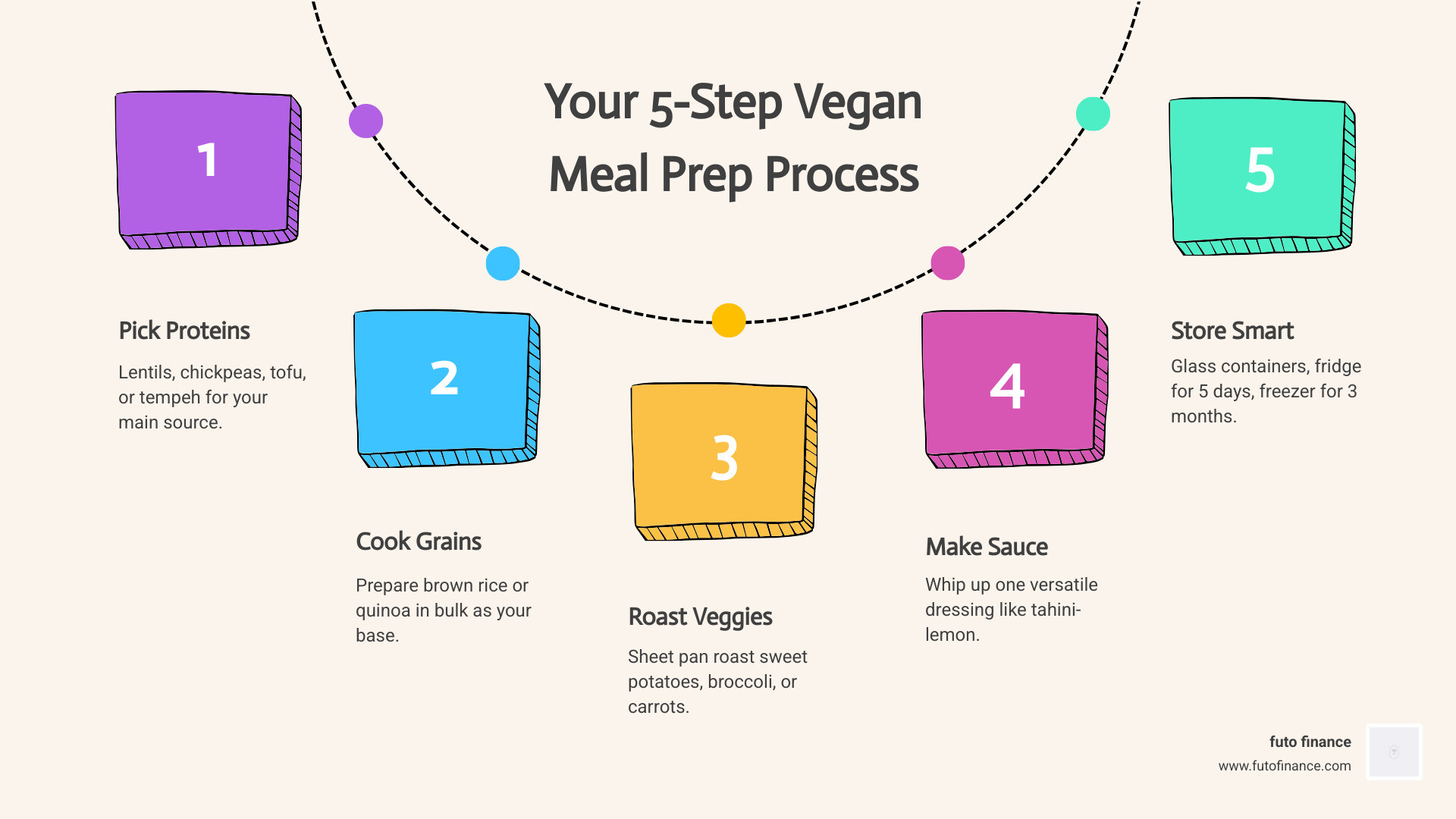
Quick answer — here’s what works best:
| Step | What to Do |
|---|---|
| 1. Pick your proteins | Lentils, chickpeas, tofu, or tempeh |
| 2. Cook a grain base | Brown rice or quinoa in bulk |
| 3. Roast your vegetables | Sweet potatoes, broccoli, carrots |
| 4. Make one versatile sauce | Tahini-lemon or peanut-ginger |
| 5. Store smart | Glass containers, fridge up to 5 days, freezer up to 3 months |
Sound simple? It is. But most people never start because they think it takes hours or requires serious cooking skills.
It doesn’t.
Research shows that prepping meals at home brings the cost per meal down to around $4, compared to roughly $20 when eating out. For a student on a tight budget, that gap adds up fast — we’re talking potential savings of $3,900 a year.
And the food? Way better than sad containers of plain rice and steamed broccoli. Done right, vegan meal prep means flavorful bowls, freezer burritos, and sauces that transform simple ingredients into completely different meals across the week.
The key insight most guides miss: you don’t cook full meals in advance. You cook components — and mix them together in different ways each day.
Why Meal Prep for Vegan Lifestyles is a Game Changer in 2026
As we move through April 2026, the world is more expensive than ever. For those of us in university, the financial pressure is real. This is where meal prep for vegan lifestyles truly shines. Not only are plant-based meals roughly 40% cheaper than those containing meat or fish, but they also tackle the massive issue of food waste. The average household currently tosses over $1,800 worth of groceries annually. By planning ahead, we ensure every spinach leaf and chickpea has a purpose.
Beyond the wallet, the health benefits are staggering. High adherence to a healthy plant-based diet has been shown to reduce Type 2 Diabetes risk by 30%. If weight management is a goal, clinical trials have shown that a low-fat vegan diet can lead to an average body weight reduction of 5.9kg over 16 weeks, thanks to the high fiber and low calorie density of whole plants.
But perhaps the biggest benefit for a busy student is the reduction in “decision fatigue.” We’ve all been there: it’s 7:00 PM on a Tuesday, you’ve just finished a three-hour lecture, and the thought of deciding what to cook feels like climbing Everest. When your fridge is stocked with prepped components, you don’t have to think—you just assemble and eat. For more on managing your cash flow while eating well, check out The Futo Finance Guide to Budget Meal Planning.
The Essential Building Blocks of Vegan Meal Prep
We don’t want you to cook five identical Tupperware containers of “boring” food. That is the fastest way to give up on veganism. Instead, we use “Component Architecture.”

This method involves prepping “flavor-neutral” bases. By keeping your grains and proteins simply seasoned, you can change the entire cuisine of your meal just by switching the sauce. One day it’s a Mexican bowl; the next, it’s a Mediterranean wrap. This system ensures “passive nutritional adequacy”—meaning you get your iron, protein, and fiber automatically because the building blocks are already nutrient-dense.
High-Protein Staples for Meal Prep for Vegan Success
Getting enough protein on a plant-based diet is easy if you prep the right staples. We recommend choosing two proteins per week to keep things interesting.
| Protein Source | Prep Method | Time | Pro Tip |
|---|---|---|---|
| Red Lentils | Simmer in water/broth | 15-20 mins | Don’t overcook! They make a great “meat” base for bolognese. |
| Firm Tofu | Press, cube, and bake | 25 mins | Toss in cornstarch before baking for extra crunch. |
| Chickpeas | Rinse or boil from dry | 5-60 mins | Roast them for a crunchy salad topper or snack. |
| Tempeh | Steam then sauté | 15 mins | Steaming first removes the natural bitterness. |
| Soy Curls | Soak and pan-fry | 10 mins | These have a “chicken-like” texture that is life-changing. |
Soy products like tofu and tempeh, along with quinoa, are “complete proteins,” meaning they contain all essential amino acids your body needs.
Versatile Grains and Roasted Vegetables
Grains are your energy source. We suggest brown rice or quinoa. Interestingly, when you cook grains and then cool them in the fridge, they develop “resistant starch.” This lowers their glycemic index, meaning you get stable energy throughout your study sessions rather than a sugar crash.
For vegetables, sheet pan roasting is our best friend. Set your oven to 425°F (220°C). Toss broccoli, sweet potatoes, and carrots in a tiny bit of oil and salt. Roasting brings out the natural sugars, making even the most “boring” veggie taste like candy. Plus, sweet potatoes are packed with beta-carotene, which is great for brain health.
Master the 60-Minute “Power Hour” Strategy
The “Power Hour” is how we get a full week of food done in the time it takes to watch one episode of a Netflix show. The secret is parallel processing. You aren’t doing one thing at a time; you’re using every tool in your kitchen at once.
- The Oven (Passive): Get your sweet potatoes and tofu roasting. Set a timer for 30 minutes.
- The Stovetop (Semi-Active): Get a big pot of rice or quinoa boiling on one burner and a pot of lentils on the other.
- The Counter (Active): While the oven and stove do the hard work, you’re at the cutting board. This is your mise en place. Chop your fresh veggies (cabbage, cucumber, kale) and whip up your sauce.
By the time the timer goes off, everything finishes at once. Let it cool, pack it up, and you’re done.

Mix-and-Match Component Architecture
Now for the fun part: assembly. With your prepped items, you can create a “permutation matrix” of meals.
- The Mexican Bowl: Brown rice + black beans + roasted sweet potato + salsa.
- The North African Plate: Quinoa + chickpeas + roasted carrots + tahini-lemon sauce.
- The Syrian-Lebanese Plate: Hummus + roasted veggies + massaged kale + chickpeas.
- The “I’m in a Rush” Wrap: Throw any of the above into a tortilla and go.
The Tahini-lemon sauce is the MVP here. Mix tahini, lemon juice, a splash of water, and garlic. It lasts all week and makes everything taste professional.
Avoiding Common Mistakes in Meal Prep for Vegan Plans
Even pros make mistakes. Here’s how to avoid the most common pitfalls:
- The Soggy Salad: Never dress your greens in advance. Keep the sauce in a separate small jar or at the bottom of a “salad jar” underneath the heavy beans.
- Storing Hot Food: Putting steaming hot containers in the fridge creates condensation (hello, sogginess!) and can actually raise the fridge temperature to unsafe levels. Let food reach room temperature first.
- The Monotony Trap: Don’t prep the same meal for 7 days. Use the 80/20 rule: 80% whole plants, 20% “fun” stuff or convenience items like a few vegan nuggets or a store-bought dressing to keep things exciting.
- Ingredient Overlap: Buy ingredients that work in multiple ways. A bag of spinach can go in a smoothie, a stir-fry, and a salad. This cuts costs and waste.
Storage and Safety: Keeping Your Prepped Meals Fresh
To keep your meal prep for vegan food safe, you need to think like a chef. Your fridge should be at 40°F (4°C) or below. We strongly recommend glass containers. They don’t hold onto smells (unlike plastic), they are BPA-free, and you can pop them straight into the microwave or oven.
Use the FIFO method (First In, First Out). Put the newest meals at the back and the ones that need eating sooner at the front. When reheating, ensure the food reaches an internal temperature of 165°F (74°C) to kill any lingering bacteria.
Fridge vs. Freezer Guidelines
Not everything lasts forever. Here is our quick-reference guide for storage:
- Cooked Grains: 4–6 days in the fridge; up to 6 months in the freezer.
- Cooked Legumes (Beans/Lentils): 3–4 days in the fridge; 2–3 months in the freezer.
- Roasted Vegetables: 4 days in the fridge (they get softer over time).
- Fresh Chopped Veggies: 3–5 days (keep a damp paper towel in the container with kale or spinach to keep it crisp).
- Sauces: 5–7 days (tahini and peanut sauces hold up well).
Pro tip: If you realize on Wednesday that you won’t finish all your prepped beans, move them to the freezer immediately rather than waiting until they smell funky on Friday.
Frequently Asked Questions about Meal Prep for Vegan Diets
How long does vegan meal prep stay fresh in the fridge?
Most cooked vegan components stay fresh and safe for 4 to 5 days. Grains like rice and quinoa are the most durable, while roasted veggies like zucchini or mushrooms might get a bit watery by day four. To maintain the best texture, store sauces separately and add fresh elements (like avocado or cilantro) right before eating.
Can vegan meal prep help with weight loss in 2026?
Absolutely. Because you are controlling the ingredients, you can avoid the hidden oils and sugars found in takeout. Focusing on “high-volume, low-calorie” foods—like greens, beans, and whole grains—allows you to eat large, satisfying portions while maintaining a calorie deficit. The high fiber content also keeps you full for longer, preventing those 11:00 PM vending machine runs.
What are the best containers for vegan meal prep?
Glass is the winner for sustainability and health. Look for “snap-top” lids with silicone seals to prevent leaks in your backpack. If you are on a budget, repurpose glass jars (like old pasta sauce jars) for overnight oats or salad dressings. If you must use plastic, ensure it is BPA-free and avoid heating it in the microwave to prevent chemical leaching.
Conclusion
At Futo Finance, we believe that being a student shouldn’t mean surviving on instant noodles. Meal prep for vegan lifestyles is your ultimate shortcut to high performance, better health, and a much healthier bank account. By spending just one hour on a Sunday afternoon, you can reclaim hours of your week and thousands of dollars a year.
Ready to start your journey? Whether you’re looking for Full Week Vegan Meal Prep: Complete Guide or just a few quick snacks to get through finals, we’ve got your back. Stop stressing about “what’s for dinner” and start enjoying the Shortcut to easy vegan living. Happy prepping!

Melo Rodrigues is the founder of Futo Finance and a specialist in student-budget veganism. Having mastered the art of plant-based cooking in a university setting, Melo is dedicated to helping students achieve nutritional excellence without financial strain. Through Futo Finance, Melo shares lab-tested strategies for eating smart and living sustainably on a budget.
