
Low Budget Vegan Cooking for People Who Love Money and Food
You Can Eat Vegan for $5 a Day — Here’s How
Low budget vegan cooking is one of the smartest money moves a student can make in 2026.
Quick answer: the cheapest vegan meals to start with
- Lentil dal with rice — under $0.70 per serving
- Black bean tacos — under $1.00 per serving
- Oats with peanut butter and banana — under $0.50 per serving
- Chickpea curry with frozen veg — under $1.00 per serving
- Pasta with lentil tomato sauce — under $0.80 per serving
The core strategy is simple: build meals around dried legumes, whole grains, frozen vegetables, and a handful of pantry staples. That combination can get your food costs down to roughly $5 a day without cutting corners on nutrition.
Here’s the thing most people get wrong: they think vegan eating means expensive specialty products, fancy meat substitutes, and overpriced oat milk lattes. It doesn’t. The cheapest items in any supermarket — lentils, rice, oats, canned tomatoes, frozen spinach — are also some of the most nutritious foods on the planet.
Households that shift to a whole-food plant-based approach commonly cut 10–20% from their grocery bill. For a student already watching every dollar, that’s real money back in your pocket every single week.
This guide will show you exactly how to do it — from building your pantry to batch cooking on a Sunday to making simple food taste genuinely good.
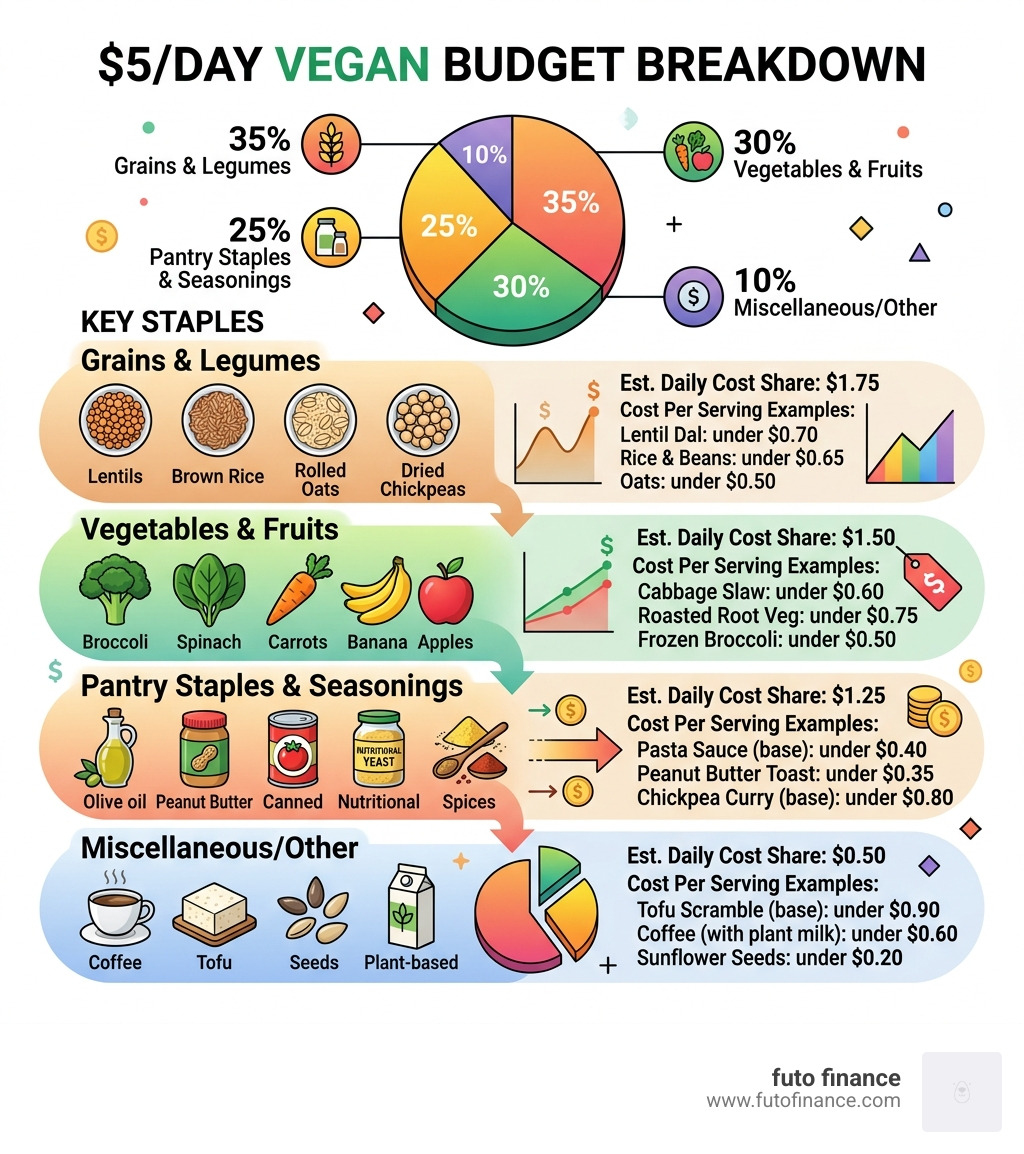
The Mindset of Strategic Abundance: Why Veganism Isn’t a Luxury
At Futo Finance, we hear the same myth every day: “Eating vegan is a luxury for people with too much time and money.” As we move through April 2026, the economic outlook makes it clear that the opposite is true. Low budget vegan cooking is actually a strategy for abundance, not deprivation.
When we talk about strategic abundance, we mean getting the most nutrients, flavor, and energy out of every single dollar. By avoiding expensive meat replacers and artisanal vegan cheeses—which can easily double your bill—and focusing on whole foods, you can achieve a 10-20% reduction in your total food spend.
Beyond the wallet, there is the environmental win. Plants require significantly less water and land than animal products. Choosing a bean-based chili over a beef-based one means fewer greenhouse gases and more resources saved. It is the ultimate “win-win” for students who care about their bank balance and the planet. Accessibility is the goal here; you don’t need a specialty health store when the most powerful ingredients are sitting on the bottom shelf of your local discount supermarket.
The $5-a-Day Pantry: Essential Ingredients for Low Budget Vegan Cooking
Every successful budget cook knows that the battle is won in the pantry. If you have the right foundations, you are never more than 15 minutes away from a filling meal. The “MVP” of the vegan pantry is undoubtedly the dried legume.
Dried beans and lentils expand 2–3 times their dry weight when cooked. This means a single $2.00 bag of dried chickpeas can provide the protein for five or six meals. Compare that to the price of a single chicken breast, and the math becomes undeniable.
Budget Pantry Essentials
- Dried Legumes: Red lentils (the fastest cooking), green lentils, black beans, and chickpeas.
- Whole Grains: Brown rice, oats, and whole-wheat pasta. Buy these in the largest bags available to lower the unit price.
- Frozen Vegetables: Spinach, peas, and mixed stir-fry veg. These are often flash-frozen at peak ripeness, making them more nutritious than “fresh” produce that has sat on a truck for a week.
- Canned Basics: Diced tomatoes and coconut milk for creamy curries.
- Flavor Anchors: Peanut butter (great for sauces and breakfast), nutritional yeast (for a cheesy hit), and soy sauce.
| Ingredient | Canned/Pre-cooked Cost | Dried/Bulk Cost | Savings |
|---|---|---|---|
| Chickpeas | $1.20 per can | $0.25 per serving | ~80% |
| Black Beans | $1.15 per can | $0.22 per serving | ~81% |
| Lentils | $1.50 per can | $0.18 per serving | ~88% |
Master the System: Meal Planning and Batch Cooking for Students

For a busy student, time is just as valuable as money. This is where the “1/3 Plate Rule” comes into play. To ensure you stay full and energized for lectures, aim to compose your plate of 1/3 grains, 1/3 protein (beans/tofu), and 1/3 vegetables.
We recommend focusing on “autopilot” recipes—dishes that take 15-30 minutes and use ingredients you always have. If you’re working with limited equipment, like a single hot plate or a microwave in a dorm, lean heavily on canned beans and quick-cook grains like couscous or red lentils.
Batch Cooking: The Engine of Low Budget Vegan Cooking
Batch cooking is the secret to avoiding $15 takeaway orders when you’re tired on a Tuesday night. We suggest picking a “Lazy Sunday” to prep 2-3 main dishes.
- Grains: Cook a massive pot of rice or quinoa.
- Proteins: Simmer a big batch of dried beans or bake two blocks of tofu.
- The “Hero” Sauce: Make a large jar of peanut satay or tahini dressing.
By scaling recipes up, you utilize heat and time more efficiently. Portion these into containers and freeze half. Freezing in single servings prevents waste and ensures that “past-self” is always looking out for “future-self.”
Smart Shopping and Waste Reduction Strategies

To keep your spending under that $5-a-day target, you need to shop with intention. First, always compare unit prices. The big flashy “Sale” sign might be a distraction; look at the cost per 100g or per pound to find the true winner.
Second, seek out ethnic grocers. Mainstream supermarkets often mark up items like spices, lentils, and tahini. A local international market can often save you 40-60% on these exact same staples. Don’t forget the “ugly” produce section—crooked carrots and bruised apples taste exactly the same in a soup or smoothie but cost a fraction of the price.
Minimizing Waste in Low Budget Vegan Cooking
Food waste is literally throwing money in the trash. The average household can save hundreds of dollars a year just by managing their fridge better.
- FIFO Method: “First In, First Out.” Move older produce to the front of the fridge so you use it before it wilts.
- Use-Up Nights: Dedicate Thursday night to a “kitchen sink” stir-fry or soup using whatever bits of veg are left.
- Vegetable Stock: Keep a container in your freezer for onion skins, carrot ends, and celery scraps. When it’s full, boil it with water for free, high-quality veggie broth.
- Airtight Storage: Store your bulk grains and dried beans in sealed jars to prevent spoilage and keep pests away.
Nutritional Mastery: Meeting Your Needs on a Budget
A common concern with low budget vegan cooking is whether you can actually stay healthy. The answer is a resounding yes. A typical adult protein target of 50–70 grams per day is easily met with staples like lentils (18g per cup) and peanut butter.
However, there are a few “non-negotiables” you should know about. According to scientific research on plant-based nutrition, a well-planned vegan diet is suitable for all stages of life, but it requires attention to specific micronutrients.
- B12: This is the only nutrient not reliably found in plants. You must use fortified foods (like plant milks or nutritional yeast) or a low-cost supplement. A 6-month supply of B12 usually costs less than $10.
- Iron: Boost absorption by pairing iron-rich foods (beans, spinach) with Vitamin C (lemon juice, bell peppers, tomatoes).
- Omega-3s: You don’t need expensive algae oils. Two tablespoons of ground flaxseeds or chia seeds in your morning oats will cover your daily needs for pennies.
- Calcium: Look for “calcium-set” tofu (check the label for calcium sulfate) and fortified plant milks.
Flavor Hacks for Low Budget Vegan Cooking
Inexpensive food doesn’t have to be bland. Professional chefs use simple techniques to make “cheap” ingredients taste like restaurant meals:
- Toast Your Spices: Before adding liquid to a curry or stew, fry your dry spices in a little oil for 30 seconds. It “wakes up” the oils and deepens the flavor.
- The Power of Acid: If a dish tastes “flat,” it usually needs acid, not more salt. A squeeze of lemon or a splash of cheap vinegar can transform a lentil soup.
- Umami Depth: Use soy sauce, tomato paste, or mushrooms to add “meatiness” to your dishes without the meat.
- Texture Variety: Add crunch to soft meals with toasted sunflower seeds or even crushed pretzels (a great budget hack!).
Frequently Asked Questions about Low Budget Vegan Cooking
Is it possible to get enough protein on a $5-a-day vegan diet?
Absolutely. Dried black beans offer about 150g of protein for every $2.00 spent. If you center your meals around legumes, whole grains, and the occasional block of tofu, you will easily hit the 50-70g daily target without needing expensive protein powders.
Are frozen vegetables as nutritious as fresh produce for budget cooking?
In many cases, they are more nutritious. Fresh produce loses vitamins during transport and while sitting on shelves. Frozen vegetables are processed immediately after harvest, locking in their nutrient profile. They also come pre-chopped, saving you time.
Do I need expensive kitchen gadgets like an Instant Pot to save money?
No. While an Instant Pot or slow cooker can save time when cooking dried beans, a simple heavy-bottomed pot with a lid can do everything you need. If you don’t have a pressure cooker, just remember to soak your beans overnight to reduce stovetop cooking time.
Conclusion
At Futo Finance, we believe that low budget vegan cooking is the ultimate life hack for students. It allows you to take control of your health, reduce your environmental footprint, and keep your bank account in the green—all while eating delicious, hearty meals.
By shifting your mindset from “deprivation” to “strategic abundance,” you can turn basic supermarket staples into a culinary system that serves you. Whether it’s a smoky bean chili or a creamy peanut noodle salad, these meals prove that you don’t need a fortune to eat like royalty.
Ready to start your journey? We’ve got plenty more resources to help you thrive. For more info about vegan cooking services, recipes, and student-specific nutrition tips, explore our latest guides and meal plans. Your wallet (and your stomach) will thank you!

Melo Rodrigues is the founder of Futo Finance and a specialist in student-budget veganism. Having mastered the art of plant-based cooking in a university setting, Melo is dedicated to helping students achieve nutritional excellence without financial strain. Through Futo Finance, Melo shares lab-tested strategies for eating smart and living sustainably on a budget.
